
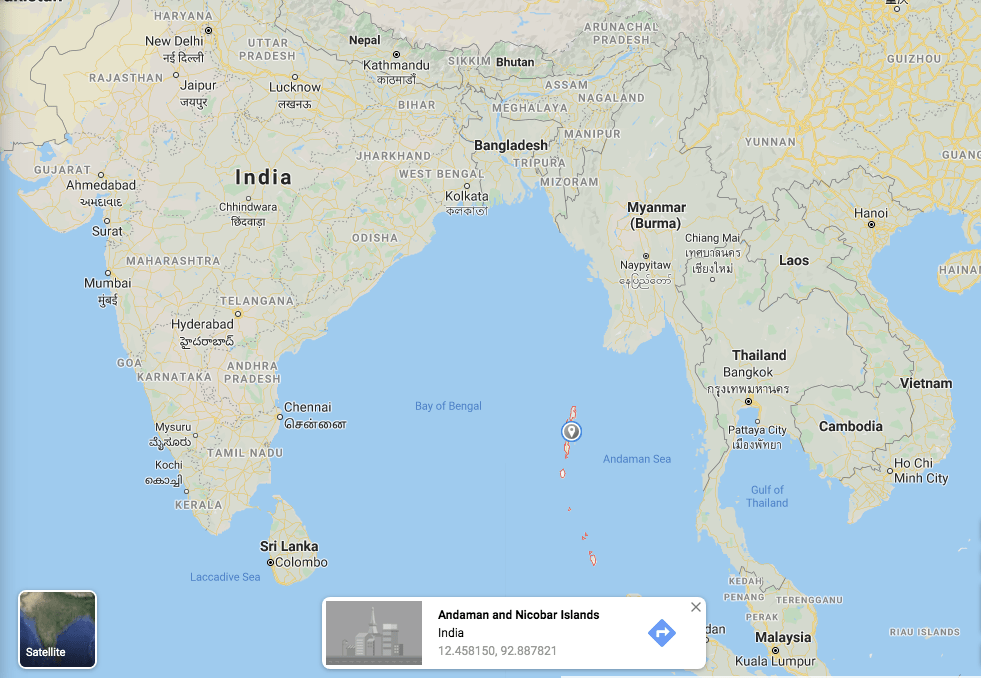
We flew from the New Delhi airport to Port Blair with Air India. Apparently, Air India is among the very few airlines serving Port Blair, although this is expected to change soon with the opening of a new international airport. Upon our early morning arrival at the Port Blair airport, we found the plane to be completely full, and we appeared to be the only non-Indians onboard. The flight itself was quite interesting and turned out to be an experience of its own. It seemed like a significant portion of the passengers had either never flown before or simply disregarded the rules. For example, there were individuals standing up during takeoff and landing, walking around the plane despite the cabin crew’s instructions to remain seated. I couldn’t help but feel sympathy for the cabin crew as they made sincere efforts to manage the situation, facing significant challenges along the way.
After landing, we walked a few meters to reach the bus that would take us to the terminal building. If you’ve flown before, you probably know that ordinarily, you’re not allowed to walk right underneath the wing of the plane. Well, that wasn’t the case here. Everyone just walked right under the engine, and no one seemed to find that strange. The bus picking us up was a very old, red vehicle. Inside the bus, I found it quite interesting how all the men gave away their seats to women. Well, except for me, maybe because I am not Indian.
Visa and permit
Before heading to the Andaman Islands, I had numerous questions for which I couldn’t find answers anywhere. For instance, I was uncertain about whether I could enter Port Blair on an E-visa. Even after reaching out to the Indian embassy in Norway, I couldn’t obtain a clear response, and they recommended getting a full visa just to be safe. After conducting thorough research, I discovered that as long as you visit another city in India first, which permits entry with an E-visa, you can safely travel to the Andaman Islands. This is due to having already received the Indian stamp in your passport, and your subsequent journey to the Andaman Islands is considered a domestic flight. That was indeed the case, although, based on my understanding, you can now also arrive directly at Port Blair with an E-visa. However, it’s unclear whether the same rules apply if you arrive by a cruise ship. Additionally, there is no longer a need for a permit to enter the Andaman Islands, except for Sentinel Island, which remains restricted. As for the Nicobar Islands, based on my last knowledge update, Indian tourists require a permit to visit, while foreign tourists generally cannot obtain a permit to enter these islands. However, it’s crucial to stay informed about the latest travel regulations and entry requirements, as they may have changed since my last update.
Upon entering the arrival hall, we were promptly singled out from the crowd and asked to show our passports, likely because it was quite apparent that we were non-Indians. Additionally, we received information about the rules and norms of the Andaman Islands. To our relief, our luggage arrived quickly in the arrival hall, providing us with plenty of time to reach the jetty. Initially concerned about making it in time for the ferry, we found that the entire process of exiting the airport was remarkably efficient.
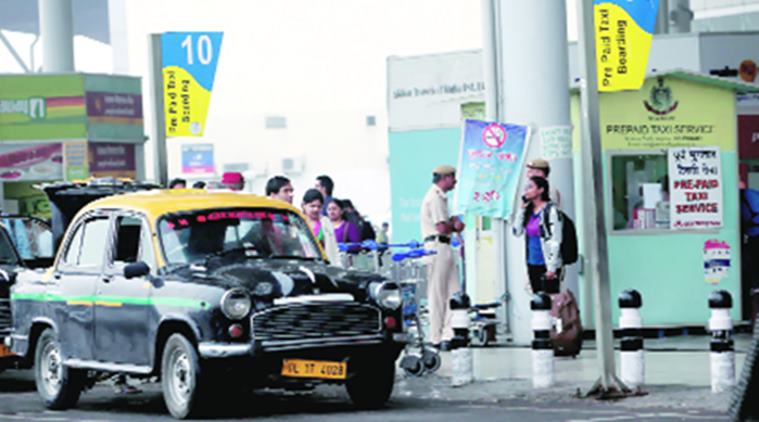
After retrieving our luggage, we stepped outside the airport. Unfortunately, we were not greeted by the best weather due to the recent cyclone. However, it was very warm and extremely humid. Our intention was to approach a taxi driver directly to take us to the jetty, but, of course, there were many people approaching us, offering taxi services. Initially, they quoted 10 USD, then 8 USD. When we expressed our preference for using rupees instead of dollars, the price dropped to 300 rupees (approximately 4 USD). While unsure if it was a good price, we considered it reasonable for a 20-minute drive, especially considering that the Andaman Islands are generally considered more expensive than mainland India. I will provide more details about the prices in the Andaman Islands in a later post.
After the scam episode in New Delhi, we remained very alert but eventually agreed to follow one of the persistent individuals. Similar to the situation in New Delhi, this person was not the taxi driver himself, and he did not accompany us for the ride; instead, he directed us to the taxi driver who took us to the jetty. The taxi itself was unlike any car I had seen before; seatbelts were non-existent, and the floor of the car was orange. It appeared to be an old British model from the 60s, black in colour with intriguing flower-patterned seats. I couldn’t help but wonder how this car was still running. Despite its appearance, the most crucial aspect was that we did not fall victim to a scam.
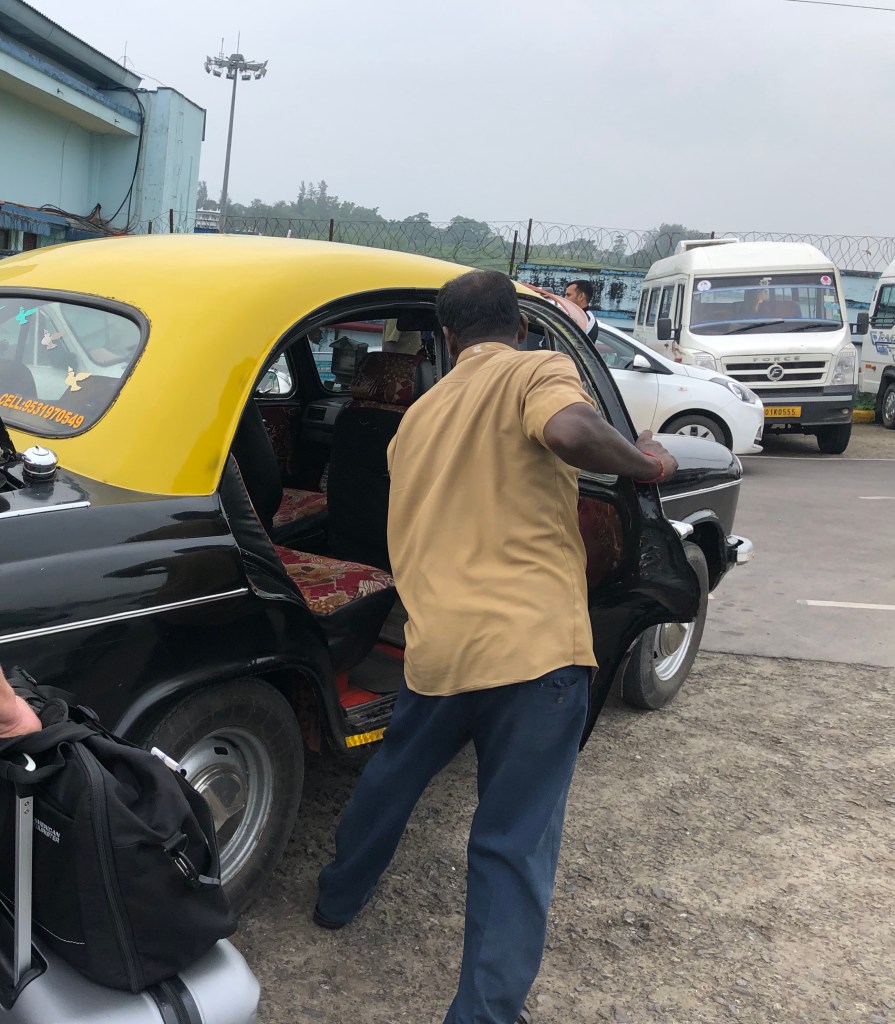


The ride to the jetty lasted around 15-20 minutes. I found it quite amusing that we were still in India because it didn’t remind me of India at all! The nature was strikingly different and tropical, with palm trees dotting the landscape and rainforests visible from every side of the road. The only reminders of India were the cows and goats wandering on the roads, the constant car honking, and women dressed in saris. Everything else, including the architecture, was remarkably distinct. The roads felt rather scary; it seemed like we were on the verge of a collision numerous times. The experience was probably even more nerve-wracking for us since we were not accustomed to driving on the left side of the road.
When we finally reached the jetty port, the gate was still closed. We were informed that the gate would open at 10:30, so we had about 10 minutes to wait. Our driver left, leaving us outside in front of the gate, alone in the rain with a goat. Shortly after, another rickshaw with Indian tourists arrived, and the gate opened. The security guard instructed us to walk straight until we reached a large building housing the ferry terminal.
Upon arriving outside the ferry terminal, we were greeted by two armed men who directed us to enter the terminal for security control. Similar to the airport experience in New Delhi, men and women had to go through separate security controls. The procedure for men resembled that of any other country, but for women, it was a bit different. Women were required to enter a small cabin, stand on an elevated box, and undergo a frisking. Whenever I stepped on this elevated box (given my height of 181 cm), half of me would stick out from the cabin, causing laughter from the security officers.

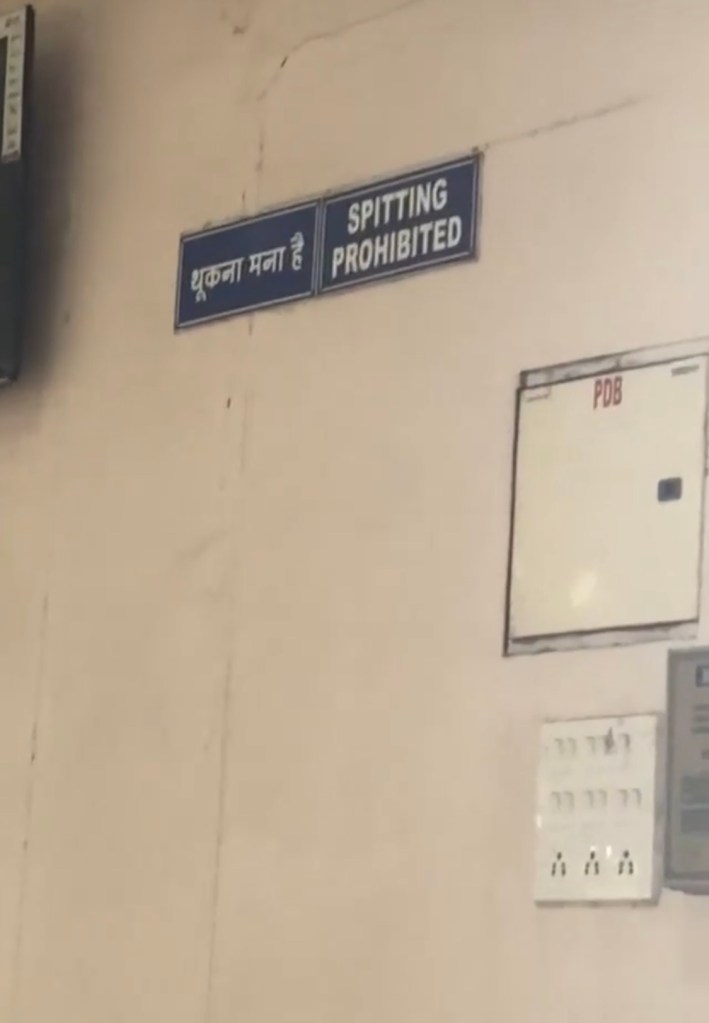
After the security control, we reached the waiting area where numerous people were already waiting. I have no clue where those people came from and when they arrived because, as mentioned earlier, the gate was closed when we got there. It was not the most pleasant waiting area I have been to. Hopefully, someone will invest in this area for the sake of tourism. There is even a sign saying “no spitting,” and I couldn’t believe that such a sign was necessary. However, the worst aspect of this ferry terminal was the bathrooms. Never have I ever seen anything like that! Most of the toilets were (very disgusting) squat toilets. Although I knew that there are typically both types of toilets, I searched for a “regular” one. I did find one, but guess what! The entire toilet was covered with thick layers of spiderwebs. I would, therefore, strongly recommend using the restroom before entering the ferry terminal or boarding the ferry.
Getting to Neil Island from Port Blair with Makruzz
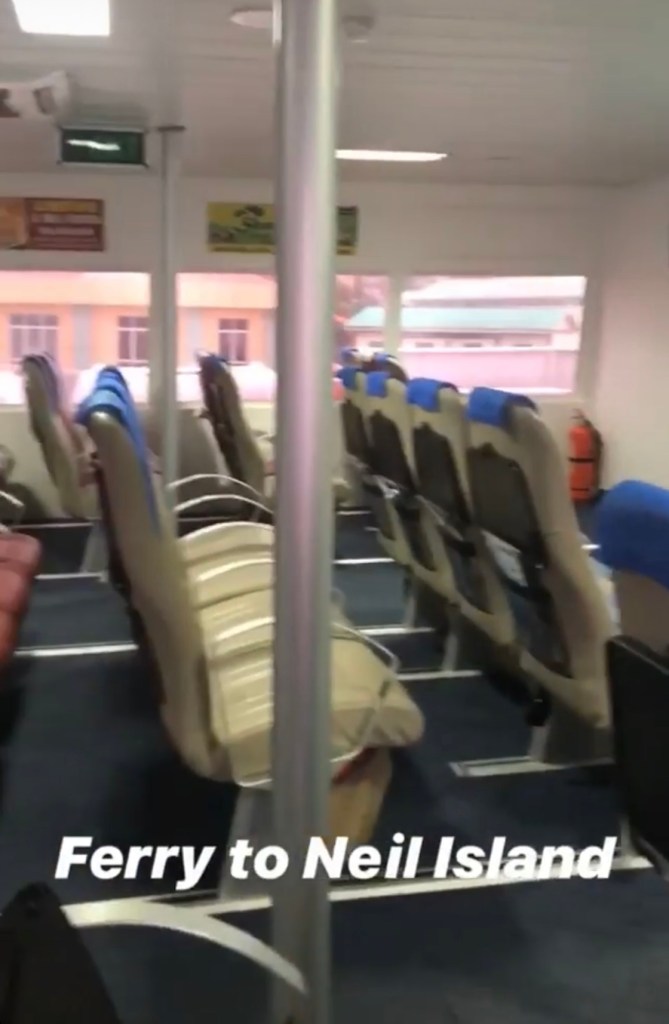
Our first destination was Neil Island, and we planned to spend three nights there. To secure tickets for our preferred ferry ride, we purchased them online a month in advance when the ticket sales opened. We opted for the “luxury” seats with Makruzz. To be completely honest, the seating choice didn’t make a significant difference because both areas were quite similar. The distinctions between the three available zones on the ferry are as follows: The luxury zone is upstairs with fewer seats, resulting in fewer people, while the economy zone is downstairs with more passengers. Some individuals mentioned a preference for the luxury zone due to its perceived quieter ambiance compared to the more crowded lower deck, but I found both areas to be relatively noisy. The third zone is a VIP room with around six seats, but it might not be practical unless you are traveling with a group of six people and seek some privacy.
We were provided with breakfast (a sandwich) and water as part of the ferry service. I’m uncertain if the economy class also includes this provision, but there was food available for purchase downstairs, such as samosas. I was pleasantly surprised by the quality of the ferry—it matched, if not exceeded, the standards of short-distance ferries in Norway! The seats were quite comfortable, and TVs played Bollywood music videos. As for luggage, the staff took care of it before we boarded the ferry and returned it to us upon arrival on Neil Island. The ferry ride had some waves, but fortunately, it wasn’t turbulent enough to cause motion sickness. Additionally, the bathrooms on the ferry were surprisingly decent, unlike those at the terminal. I would advise waiting until you get on the ferry rather than using the restrooms at the terminal.
From the jetty port on Neil Island, we opted for a taxi to reach our hotel. With numerous rickshaws and taxis readily available by the jetty, finding transportation was not an issue. Being the only non-Indians made it even more convenient, as most rickshaw and taxi drivers approached us instantly. The journey to our hotel lasted about 10 minutes. Given Neil Island’s small size, I believe this is the maximum distance to most hotels.
In the next post, I’ll provide more details about our hotel and share insights about Neil Island in general!


























 Anyah Mroz